The Waitākere Ranges Heritage Area is threatened
This recent EDS article in the Herald highlights the threats posed to the protective nature of the Waitākere Ranges Heritage Area. This is something the Local Board has been concerned about for a while and we have pushed for Auckland Council to submit that the Waitākere Ranges Heritage Area Act 2008 needs to be protected.
Following is the submission that we have made which is released publicly in the interests of transparancy. Short version, we should be very afraid …
Introduction
1. The Waitākere Ranges Local Board wishes to make the following submission in relation to the Natural Environment Bill and the Planning Bill.
Background
2. The local board has a number of concerns about the Bills.
3. The first relates to the effect on the Waitākere Ranges Heritage Area Act 2008.
4. This is a local act passed at the request of the then Waitākere City Council.
5. It designates the Waitākere Ranges as an area of national significance and puts in place a number of measures to ensure that the core nature of the area is protected.
6. The Act has its genesis in the report by the then Parliamentary Commissioner for the Environment Morgan Williams who in 2000 famously said that if the system was not changed then the Waitākere Ranges would suffer "death of a thousand cuts".
7. This was because planning decision by planning decision there would be a creeping degradation of the area. This would occur whether through continuous consent application decisions or through District Plan changes.
8. In particular Williams said:
"Many of the environmental attributes important to most I spoke with are at risk in the longer term; it will be death by a thousand cuts. It will not be the intent of all involved; the legislation and district plan will be adhered to; the aspirations of individual families and developers will be accommodated in a fair and just way – but the end result will not satisfy the majority!
This is why a strong, self-reinforcing vision of how the community wants the Waitākere Ranges to be in the future is critical. The key attributes that are important must be identified and measures to maintain them, developed.”
9. The preparation of the Act can be directly linked to his report. It was developed and consulted on over an extended period of time. Although it was contentious in some quarters at the time it was passed it now enjoys a remarkable level of support. Locals cherish and celebrate living in a specially designated area and many volunteer to help to preserve and enhance the local environment.
10. A very simple description of the effect of the Act is that it sets out the National significance of the area, its heritage features and establishes protective objectives for the area. It then requires decision makers when making decisions on plan formation or changes or some resource consent applications to have particular regard to protection of the heritage features and objectives for the area.
11. The Act provides for five yearly reports on the operation of the Act. Successive reports have confirmed that the Act is working as intended. Subdivision has been limited and urban sprawl has been effectively stopped.
12. And the area is fragile as shown by the damage caused by the Anniversary Weekend storm in 2023. In Titirangi and out west there were a significant number of houses purchased by Council as part of the buy out process of category three properties.
Concerns about Bills
13. The Local Board has taken a major interest in the Act and in the Heritage Area since inception. We are concerned at the implications that the proposed RMA changes pose for the Heritage Area.
14. These include the following.
The Bills do not make amendments to the Waitākere Ranges Heritage Area Act
15. Although the Planning Bill has a schedule making consequential amendments to various pieces of legislation this does not include the Waitākere Ranges Heritage Area Act. I presume this is through oversight. Schedule 11 of the Bill contains the amendments to public Acts. They refer to the Resource Management Act (RMA), the Local Government (Auckland Council) Act, the Conservation Act, the Crown Minerals Act and a number of other Public Acts. There is also schedule 6 of the Natural Heritage Bill and schedule 12 of the Planning Bill which makes changes to various statutory acknowledgements of Treaty Settlements. The Heritage Area Act is a local act. This omission has a number of effects on the Heritage Area Act.
16. This has a major effect on the efficacy of the Heritage Area Act.
17. For instance it is noted that Regional Plans and District Plans are replaced by Regional Spatial Plans and Land Use Plans. It is submitted that sections 10 and 11 of the Heritage Area Act should be amended to provide that when preparing a Regional Spatial Plan or a Land Use plan Council should have particular regard to the provisions of the Heritage Area Act.
18. Section 12 of the Heritage Area Act refers to various machinery provisions in the RMA. To preserve their effect these provisions should either be remapped onto the new legislation or preserved under a local continuation of the current system.
19. Section 14 of the Heritage Area Act, which refers to conditions that can be imposed to be effective will need the reference to the RMA changed to section 150 of the Planning Bill.
20. Section 15 of the Heritage Area Act which refers to Designations or Heritage orders will need to have their reference to the RMA changed. And applications under section 16 of the WRHA which refers to declaration, enforcement orders and abatement notices will also need to be updated.
21. The Heritage Area Act includes the power to create local area plans. These are expressions of local preference for the long term protection of their area. Although none are currently being considered this section's reference to the RMA should be updated.
22. Further the Minister has considerable powers to direct changes to land use plans. We submit that when making a decision affecting the Heritage Area the Minister should be required to give particular regard to the objectives of the Heritage Area Act.
Changes to the number of activity classes also affects the operation of the WRHA.
23. There are four activity categories in the new Act included prohibited, discretionary, restricted discretionary and permitted. Currently under the RMA there are also non complying and controlled activities. Under section 13 of the WRHA if an activity is a non-complying activity then particular regard must be had to the purposes of the Act. If the activity is a controlled activity or a restricted discretionary activity then the purpose of the Act has to be considered as if it is a matter specified in the Act.
24. Removing non-complying and controlled activities from the legislation will have significant effects on these provisions. The change will limit the effect of the Act and lessen the number of applications where the Act needs to be considered.
Removal of "hard" urban-rural boundary
25. The Minister has indicated that "hard" rural urban boundary requirements will be removed. This will allow for urban creep and was one of the matters that the Heritage Area Act addressed. The intent was to create a "hard" boundary through setting rigid subdivision limitations with the further requirement that changes that affected the protective nature of the this requirement would be difficult if not impossible to achieve.
26. It does not appear that this particular power is contained in the Bill and it is anticipated that the Minister will seek to achieve this by way of National Policy Direction and the setting of National Rules.
27. The Planning Bill provides the Government with significant power to affect changes to local planning instruments. The level of centralised power is reminiscent of powers assumed by the Government during the Muldoon years or planning powers enjoyed by the former Soviet Union.
28. A National Rule can classify an activity as a permitted activity or restricted discretionary activity and this will require consents to be granted provided that in the case of a restricted discretionary activity the matters on which the discretion is reserved are met (section 32 Planning Bill).
29. If a National Rule classifies an activity as a restricted discretionary activity then it must specify the matters over which discretion is reserved (section 32(3)).
30. It is anticipated that the Government could set National Rules that apply to rural land adjacent to urban zoned land and by this method it could allow subdivisions to occur conditional on the provision of adequate infrastructure. This could be used to undermine a significant protection provided by the Heritage Area Act.
31. If so the Government ought to be required to take into account the objectives of the Heritage Area Act.
32. There is a very practical reason why this should occur. The Anniversary Weekend storm damage to the Ranges was significant and it is clear that parts of the Heritage Area including Titirangi, and Laingholm are at or beyond their carrying capacity. Allowing further subdivision in these areas will mean that land instability will inevitably increase. There is also the cumulative effect of decreased permeability meaning increased downstream flooding incidents.
Other matters
33. The local board wishes to comment on the following matters:
Compensation for imposition of Outstanding Natural Features Overlay
34. This is another area which could affect the Heritage Area. Currently a large part of the Heritage Area Act is covered by an Outstanding Natural Feature overlay. The following map indicates the extent of the cover.
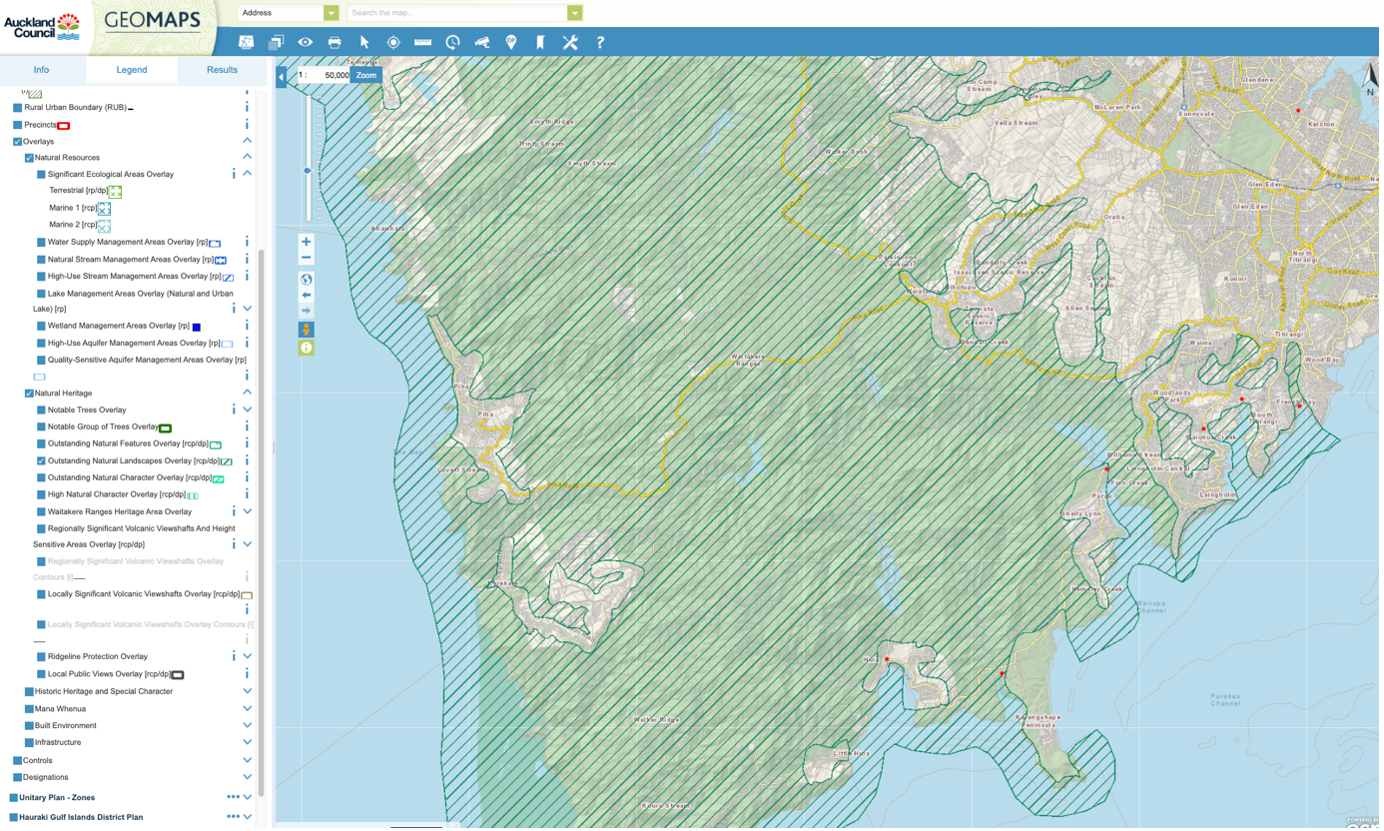
35. The Planning Bill proposes that landowners receive regulatory relief if their landowner rights are affected by the imposition of certain planning restrictions. These include adding controls to protect outstanding natural landscapes and features or areas of high natural character within the coastal environment.
36. Part 4 of Schedule 3 of the Planning Act sets out the requirements for regulatory relief. The effect appears to "grandfather" in existing provisions. Section 64 of Schedule 4 requires Council to consider "the impact of the proposed rule on the reasonable use of land if the rule is substantially different in the operative plan". It is hoped that if enacted the provision will not open a floodgate of claims by currently affected landowners but certainty is sought.
37. The provision may not have an immediate effect but it will have a chilling effect on imposition of further controls, even if they are necessary, as there may be a monetary consequence for Council.
Ministerial power to direct plan changes
38. The Minister has very wide powers under clause 203 of the Planning Bill to direct a territorial authority to address planning or land use issues and to prepare change to its land use plan or a variation to a proposed land use plan that addresses the issue. There are some conditions that have to be met. The minister can also direct a territorial authority to address non compliance with a national direction. There is also power under clause 204 for the Minister to direct a local authority to achieve an outcome. From what I can see there is no comparable RMA power. The level of Ministerial power is on the face of it extreme and the local board does not understand the justification for this power.
Conclusion
39. The Local Board requests that consequential changes are made as outlined to preserve the current effect of the Heritage Area Act.
