In support of Chris Bishop
As a die heard leftie I am somewhat surprised that I am writing this.
But I believe that Chris Bishop is right about plan change 120 and the Government’s recent backtrack on what plan change 120 wanted to achieve is retrograde, bad for Auckland and brings the current consultation into disrepute.
First up a very potted history of what is involved.
The Auckland Unitary Plan, required by the Super City Reforms, allowed for significant intensification of the city most within the existing city limits. If all potential development occurred there would be 1.2 million more houses in the city. And given the housing shortage which at many stages has been a crisis, this would be welcome.
Then in 2022 the Government implemented the National Policy Statement on Urban Development (NPSUD) and Medium Density Housing Standards Rules (MDHS).
The NPSUD would have enable buildings of six storeys or more within walking distances (walkable catchments) from the city centre, the city’s 10 large metropolitan centres and around rapid transit stops. The MDRS would have allowed many Auckland property owners to build up to three homes of up to three storeys on their sites, including townhouses and terraced housing.
The two proposals would have allowed for 2 million new dwellings to be eventually built in the city over time.
The NPSUD required a plan change. The MDRS’s effects started immediately.
To implement the NPSUD Auckland Council proposed Plan Change 78. This was publicly notified in August 2022 and progressed rapidly.
But then the Anniversary Day storms hit and Council realised that it had a major problem. Allowing intensive development in flood plains and in areas with stability issues was not an optimal approach to planning for many more houses.
So Council decided to withdraw the part of the plan that had not already been adopted and proceed with a new plan, Plan Change 120, that created new rules to help protect developments from natural hazard risks, regardless of zoning, and focuses more homes in areas near jobs and public transport. The Government passed legislation to allow for this but on the basis that the original 2 million new household figure would still be catered for.
Council then advertised Plan Change 120, and invited submissions. More than 10,000 submissions had been received by the time the submissions period closed on December 9, 2025.
It is then that things became really interesting. Even though the proposal, avoiding flood prone or stability sensitive areas, appeared to be very rational it created some opposition.
From Bernard Orsman at the Herald:
Former National Cabinet Minister Maurice Williamson is urging the Government to pull back from its mandated intensification plans for Auckland, warning it is leading to public anger that will cost the party votes at next year’s election.
And in the first sign that sitting Auckland-based National MPs are uneasy about political fallout from Plan Change 120 - which allows for up to two million homes - Pakūranga MP and Minister for Auckland Simeon Brown said some of the proposals make no sense.
The two National Party stalwarts were speaking after a packed public meeting in Prime Minister Christopher Luxon’s Botany electorate on Tuesday.
The meeting focused on Plan Change 120, prepared by the Auckland Council under legislation overseen by Resource Management Act Minister Chris Bishop
“I came out of Tuesday’s meeting with quite strong anger at the Government for being so arrogant, for not listening, and I can tell you if Chris Bishop sticks with the two million dwelling number, and I don’t think he will, it will heavily cost National Party votes at the next election,” Williamson told the Weekend Herald.
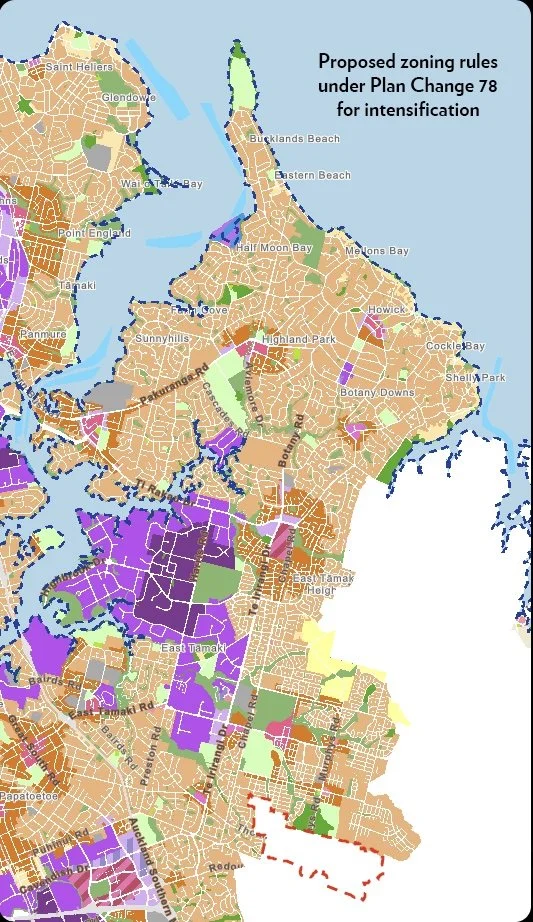
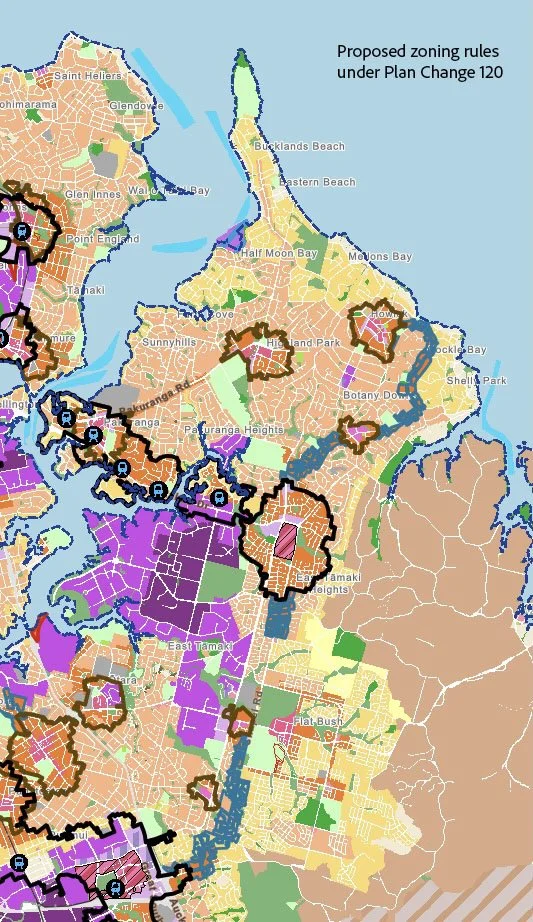
The changes in Howick were pretty minimal. There was a further transport corridor along which apartments would be allowed.
But the scaremongering is difficult to understand given that under Plan Phange 120 the Howick Local Board area would have potentially 15,466 fewer dwellings. A significant part of the area was being rezoned down from Terraced Housing to Mixed Housing Suburban.
The Howick Local Board area is predominately the seats of Pakuranga (Simeon Brown) and Botany (Christopher Luxon).
Here are the maps. You can see that under Plan Change 78 there was more intensification across most of the local board area. Yellow indicates lower density and the darkish Orange higher intensity.
Under Plan Change 120 there are generally lower density levels but increased levels along a new public transport route situated primarily in the Botany electorate. There is also an area immediately adjacent to the Howick Village that is also being primed for development.
The following table sets out changes in new dwelling distribution by local board. At first sight it appears that Albert Eden, Maungakiekie and Puketapapa are being subject to significant intensification while elsewhere mostly numbers are reducing.
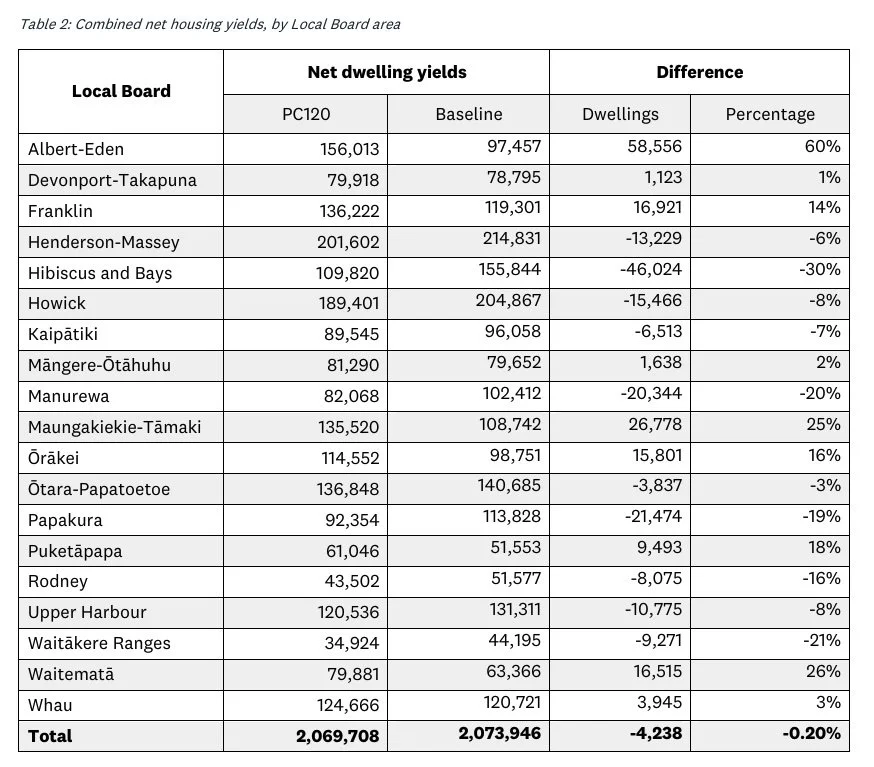
There is an explanation for this however. Plan Change 78 excluded the proposed light rail route and presumed for the purposes of the overall calculation that the two million new dwellings would be outside of this area. Here is the Plan Change 78 map showing the corridor.
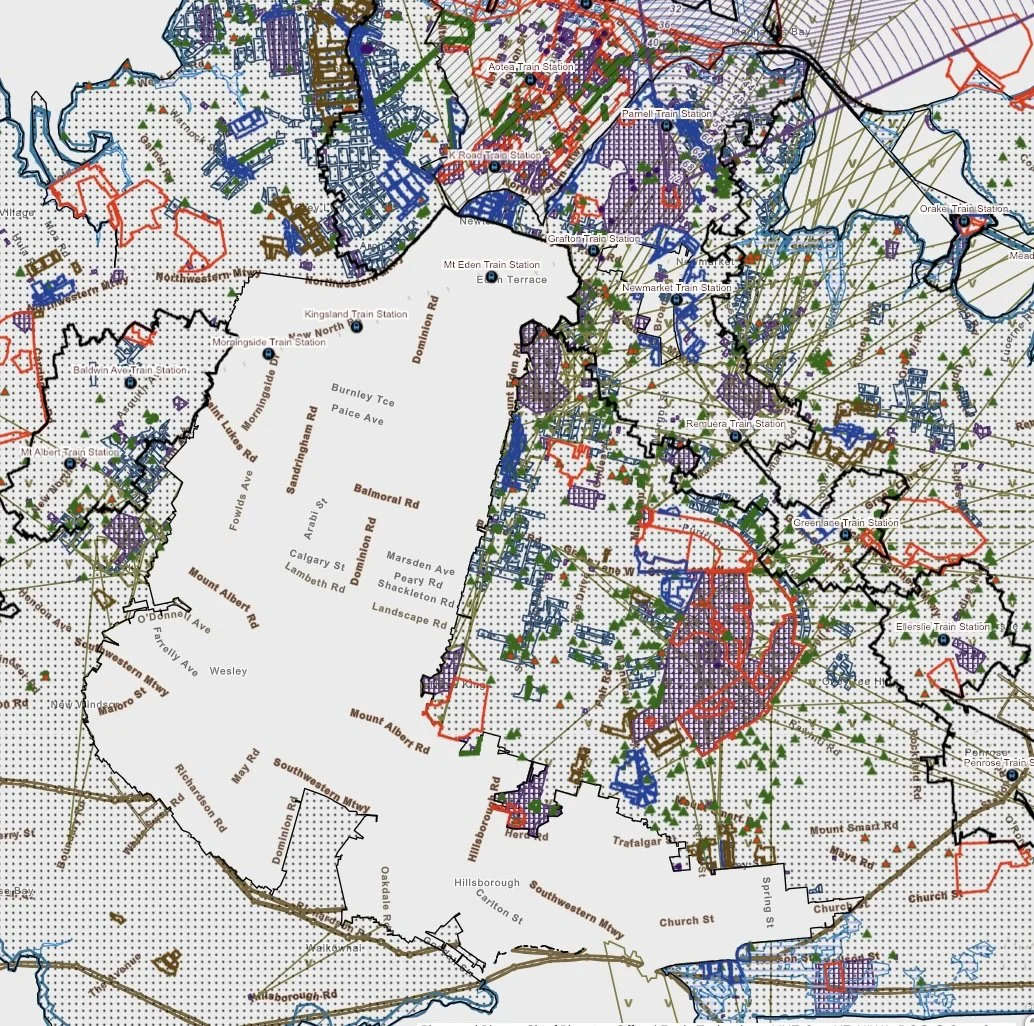
Here is the plan change 120 map showing the proposed intensification in this area which as you can see is significant.
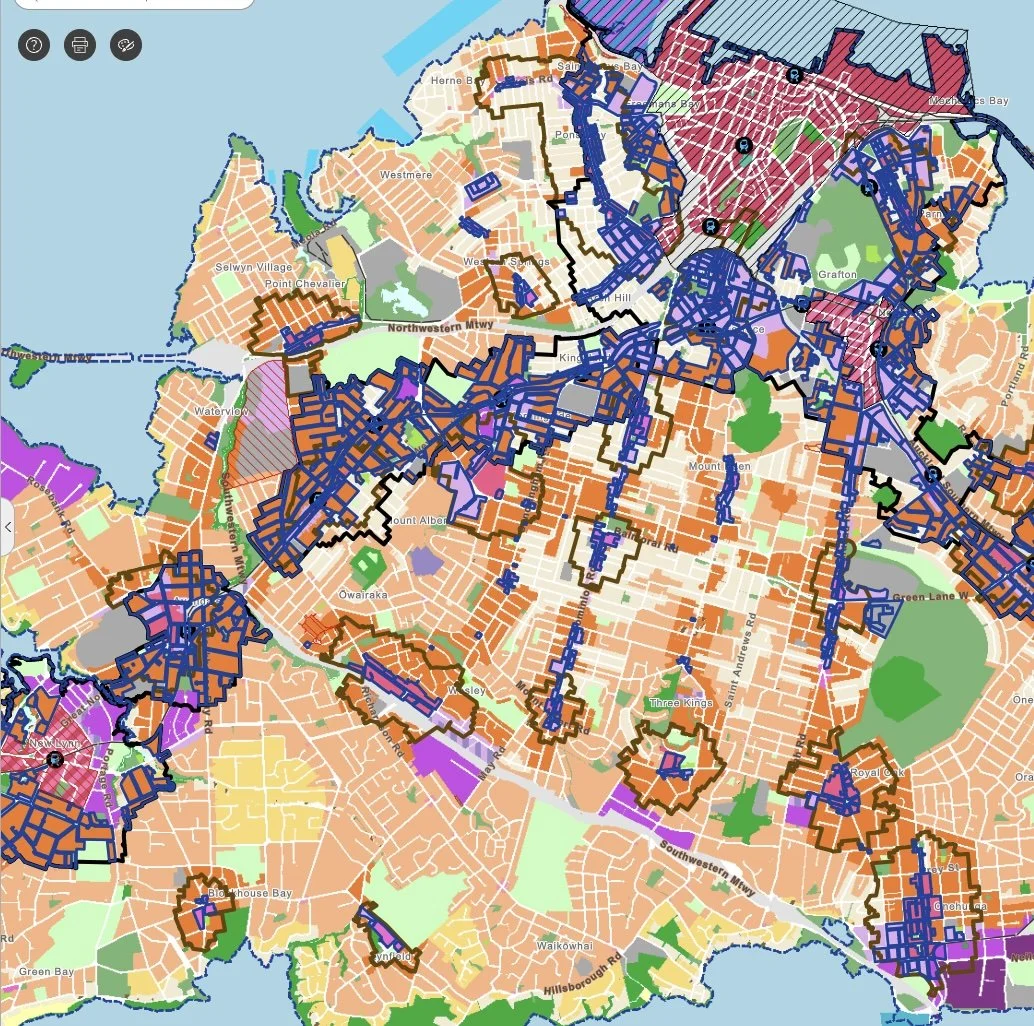
The rationale for intensification around transport routes is simple. To make Public Transport work you need to intensify intensify around rail stations and public transport hubs. This way a city becomes more sustainable. The alternative is to put up with urban sprawl and associated increased car use. Larger cities are less efficient and more costly to run. And lacking the quality of life that a well designed compact city can provide.
Plan Change 120 for most of the city represents a reduction in existing density with increased density occurring around public transport corridors and with the original approval of three dwellings per section being removed.
And Christopher Bishop is right in wanting to retain the housing target. We still have a housing crisis and need to make sure that everyone is housed and that houses are affordable.
The Governmnent’s backdown, formally announced earlier this week, has all the hallmarks of a political hit job and none of the features of a serious attempt to address Auckland’s structural problems.
The backdown has been proposed for a while. Back on January 17, 2026 Christopher Luxon dropped strong hints that there would be a reversal.
From Jonathan Killick at the Post:
Prime Minister Christopher Luxon is understood to have watered down controversial plans championed by Housing Minister Chris Bishop to intensify Auckland’s gentrified inner suburbs.
In a statement, Bishop confirmed “the Government is considering a range of options around housing capacity targets for Auckland and as Minister of Housing I will have more to say soon.”
The radical policy has been a bone of contention with National’s Auckland MPs, sparking fiery public meetings and opposition from some of the party’s staunchest supporters.
Auckland councillor – and former National MP Maurice Williamson – described it as a choice between “a lethal injection and a firing squad”.
In the background, sources say, have been secret negotiations involving Auckland mayor Wayne Brown and dissatisfied local MPs and coalition partners.
It comes as Aucklanders have submitted in droves on the controversial government mandated Plan Change 120 that would see zoning changes in the city to permit an additional two million homes – many of those in the previously-protected wealthy central suburbs.
One source close to the Government told The Post the backtrack was a Captain’s call by Luxon and reflected the pressure National’s Auckland MPs were feeling over the issue. Luxon was both “stamping his authority within the party” and demonstrating he had listened to Aucklanders.
The announcement at the time appeared imminent. But someone must have told the Government about all the legal problems.
Requiring the earler change complete with the same new dwelling target of 2 million new dwellings, then allowing Auckland Council to not only consult on the change but also complete the consultation but then backtracking raises all sorts of interesting and difficult issues.
As Bishop said “legislating in the middle of a plan change process that is already underway … is quite legally complicated” is something of an understatement. My description would be that it is fraught with deep concerns about changes not being made in good faith and will bring the whole process into disrepute.
The formal announcement was made this week and Bishop had to front it. The proposed solution is to go halfway between the previous target and the Unitary Plan’s original figure of 1.2 million and voila a figure of 1.6 million has been indicated.
Interestingly the press release also said that the legislation will also “resolve” a transitional issue “affecting approximately 400 developers and property owners who were relying on the Medium Density Residential Standards when an earlier plan change was withdrawn in 2025”. It will be interesting to see what this issue is and who is affected
About the changes Bishop said:
Cabinet has asked for a summary of the provisional zoning changes the Council would make once we legislate. And once we legislate the lower housing capacity number, the rest is in Auckland Council’s hands.
The Council will determine which parts of Auckland they wish to downzone in PC120. They can then formally withdraw parts of PC120 from the Plan Change, except for those parts needed to implement the NPS-UD or to upzone around key CRL stations.
But this last statement, that Auckland Council decides which parts of Auckland they wish to downsize does not appear to be necessarily correct.
From Tim Murphy at Newsroom:
Housing Minister Chris Bishop’s much telegraphed backdown over forcing high density housing plans across Auckland came with a late surprise – a requirement city politicians reveal where they will make changes before Cabinet agrees to a law change.
It’s understood city leaders learned of that effective veto indirectly, only as Bishop announced the Government’s attempted solution to what has become a sensitive electoral issue for National and Act MPs.
While the minister said the Government now wants Auckland Council to handle this hottest of political potatoes, the coalition has been unable to hand over the reins completely, inserting the unexpected condition into proceedings before it will agree to amend the law.
…
The requirement for Auckland Council to work out a quick summary of how it will shave those imaginary 400,000 extra homes off the planning map – and submit it to their Beehive masters – has rankled Auckland Mayor Wayne Brown and some councillors. It has also left officials puzzled by how they can move forward now through a political, planning and possibly legal minefield.
Allowing Auckland to decide where to downsize but requiring them to tell you which parts will be downsized before you grant them the power, like the change to the number of new dwellings, reeks of bad faith. A proper consultation requires the proposition of change, and consideration of responses in good faith. Being told at the beginning there is a bottom line but then changing the bottom line part way through the process makes a mockery of the whole process. And how Councillors are meant to consider the propoosal with an open mind with all of the political pressure on them is beyond me.
The only fair way would be for Auckland Council to start again but this will not happen.
It will be interesting to see which areas experience reductions and if these are in National seats.
I get the strong sense they will be and that as a result Auckland City will be less sustainable and have a poorer urban form than it could have had.
