The report back of the Planning Bill - is the Heritage Area protected?
The Local Board and I have been involved in a rather intense campaign to protect the Waitakere Ranges Heritage Area Act.
As I noted previously proposed changes to laws relating to Resource Management system had the potential to undermine the protection given to the Waitakere Ranges by the Heritage Area Act.
There were four problems:
There were a number of references to the Resource Management Act in the Heritage Area Act. Normally I would expect these to be remapped to the new legislation (Planning Act and the Natural Environment Act) but for some reason this was not done.
The regulatory relief provision, holding out the proposition of landowners receiving compensation if their use of the land was affected by planning methods such as significant ecological area or outstanding natural feature overlays.
The Planning Bill potentially gives the relevant Minister significant powers to permit activities that otherwise may be prohibited.
The Planning Bill also gave the Minister to rewrite District Plans and he or she would not be bound to respect the protective principles or objectives contained in the Heritage Area Act.
On behalf of the local board I filed submissions and I also raised concerns with Council staff and asked that that Council’s submission also addresses these issues.
The local board, with the assistance of Te Kawerau a Maki, organised a well attended public meeting. And we organised a petition through Action Station that received over 8,000 digital signatures. The petition, headed by Sir Bob Harvey, was formally presented to Parliament last week.
There was a concerted effort, with the help of Forest and Bird, to get citizens to email various MPs and urge them to protect the Heritage Area. I had a few complaints from MPs that their email inboxes were bulging so the campaign must have worked.
And there was considerable media interest, especially by Radio New Zealand and the Herald who posted detailed analyses of the problem.
Last week the Environment Select Committee released its reports on the reform bills.
How well has our campaign gone so far?
Not bad, but there remain significant threats.
RMA references in Heritage Area Act
About the campaign to protect the Heritage Area Act the report said the following:
“We understand that there is strong public concern about the treatment of the Waitakere Ranges Heritage Area in the bills as introduced. This was likely not aided by relevant consequential amendments being omitted at introduction.”
You have to wonder why the work was not done before the introduction of the bills and why the drafters did not check on links between the RMA and existing legislation.
I did. The RMA is mentioned in 247 different Acts.
Of these Acts 12 are directly amended by the first version of the Planning Bill and one Act is amended by the Natural Environment Bill. The bill as amended includes more, but I am struck by how much corrective work has been performed. This sort of work should be done before the bill is introduced, just so that members of the public can submit properly on what is proposed.
The report recommends changes to the Heritage Area Act so that Auckland Council still needs to give effect to the Heritage Area Act when preparing land use and natural environment plans.
We proposed that when Council is forming Regional Spatial Plans it should have particular regard to the provisions of the Act. The Select Committee has changed this to require plans to be “not inconsistent with“ the Heritage Area Act. In my view this is unwarranted and reduces the effectiveness of the Heritage Area Act.
By contrast Land Use Plans have to give effect to the purposes and objectives of the Act.
Our remaining proposals appear to have been addressed adequately and the remapping has occurred.
I am pleased that Auckland Council will generally have to respect the Heritage Area Act.
Regulatory Relief
This remains in the bill and in my view is the measure that will most threaten the Waitakere Ranges.
The proposition is that if there are significant restrictions on a landowner’s “reasonable” use of land then compensation should be paid. Council would need to prepare a regulatory relief framework in its land use plan. Relevant restrictions would be those imposed by outstanding natural landscapes or significant natural areas of which the Heritage Area is blessed.
For instance the existing Significant Ecological Area overlay in the Unitary Plan would presumably approximate to SNAs under the Natural Environment Bill. Although it is unclear the reimposition of this overlay could open up a claim for compensation, at least for landowners who owned the land when the Unitary Plan was put in place.
The cost could be significant with an estimate cost of up to $2 billion nationwide. Auckland’s share will be clearly significant. It will have a chilling effect on Auckland Council wanting to protect the Heritage Area.
To show how potentially drastic the provision could be following is a map of the heritage area showing the significant ecological area overlay.
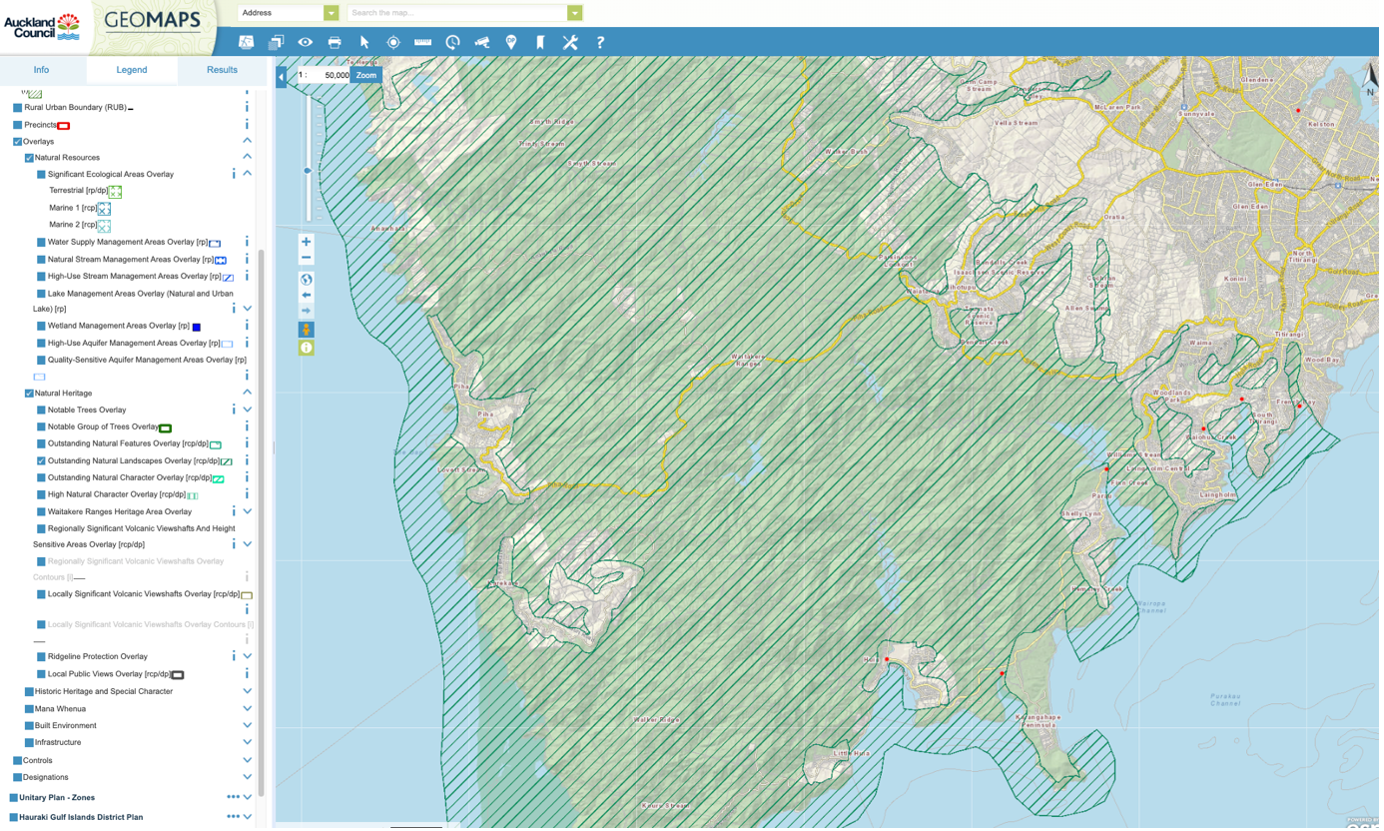
The proposal is a nonsense. In Titirangi, for instance, the SEA has the important role of protecting the forest which holds up the hills, deals with stormwater and minimises land slips. There is a community benefit from this. To put a price tag on this could cause Council to resile away from this protection and it could be devastating for the area.
Ministerial Power to permit activities
Minister Chris Bishop had previously indicated that under the new system "hard" rural urban boundary requirements would be removed. This would allow for urban creep and was one of the matters that the Heritage Area Act attempted to prevent. The intent when the Heritage Area Act was formulated was to create a "hard" boundary through the setting of rigid subdivision limitations in the District Plan. It was then the purpose of the Act to restrict Auckland Council’s ability to loosen up those restrictions over time.
Specifically he has talked about “new rules to make it easier for cities to expand outwards at the urban fringe, such as the abolishment of the rural-urban boundary in Auckland”.
There is no specific provision in either Bill that I can see implementing this and I believe that he intends to use the power to issue National Rules to achieve this.
The National Rules regime would allow the Minister to designate certain activity to be permitted. Currently subdivision in parts of the Waitakere Ranges, particularly in the foothills is prohibited if it results in lot sizes smaller than the minimum. The Minister could override this. And he does not need to take into account the protective measures in the Heritage Area Act.
The process for making National Rules is very loose. In my view this presents one of the most dangerous threats to the efficacy of the Heritage Area Act
Ministerial Power to rewrite District Plans
Under section 204 of the original Bill the Minister had powers to direct local councils to “take any action that the Minister considers necessary to achieve an outcome specified by the Minister in the direction”.
The Local Board submitted that the level of Ministerial power is on the face of it extreme and we did not understand the justification for this power.
The Committee has recommended that this particular power be amended to allow the Minister to direct a local authority to take action the minister considers necessary to “address any issue with the local authority’s exercise or performance of its functions, powers or duties”.
Conclusion
It is pleasing that the Select Committee has recommended changes to ensure that Auckland Council has to continue to respect and adhere to the Heritage Area Act.
But the Regulatory Relief provision could have a chilling effect on Auckland Council’s desire to continue with Outstanding Natural Feature and Significant Ecological Area overlays.
And the Minister’s ability to permit activities using the National Rules regime could again make subdivision of the Waitakere Ranges foothills a feature.
We are back into the situation where the Waitakere Ranges face death by a thousand cuts. We should be very afraid.
